AI vs Hiring: The Real Comparison Nobody Talks About
When most business owners think about hiring, they think about salary. But salary is only 60-70% of what an employee actually costs. The rest? Benefits, payroll taxes, recruiting fees, equipment, office space, and the one nobody budgets for—training.
The average new hire takes three to six months to reach full productivity. During that window you are paying full price for half output. You are also burning your own time (or a manager’s time) answering questions, reviewing work, and fixing mistakes. According to the Society for Human Resource Management, the average cost-per-hire in the U.S. is over $4,700—and that number climbs fast once you factor in lost productivity during the vacancy.
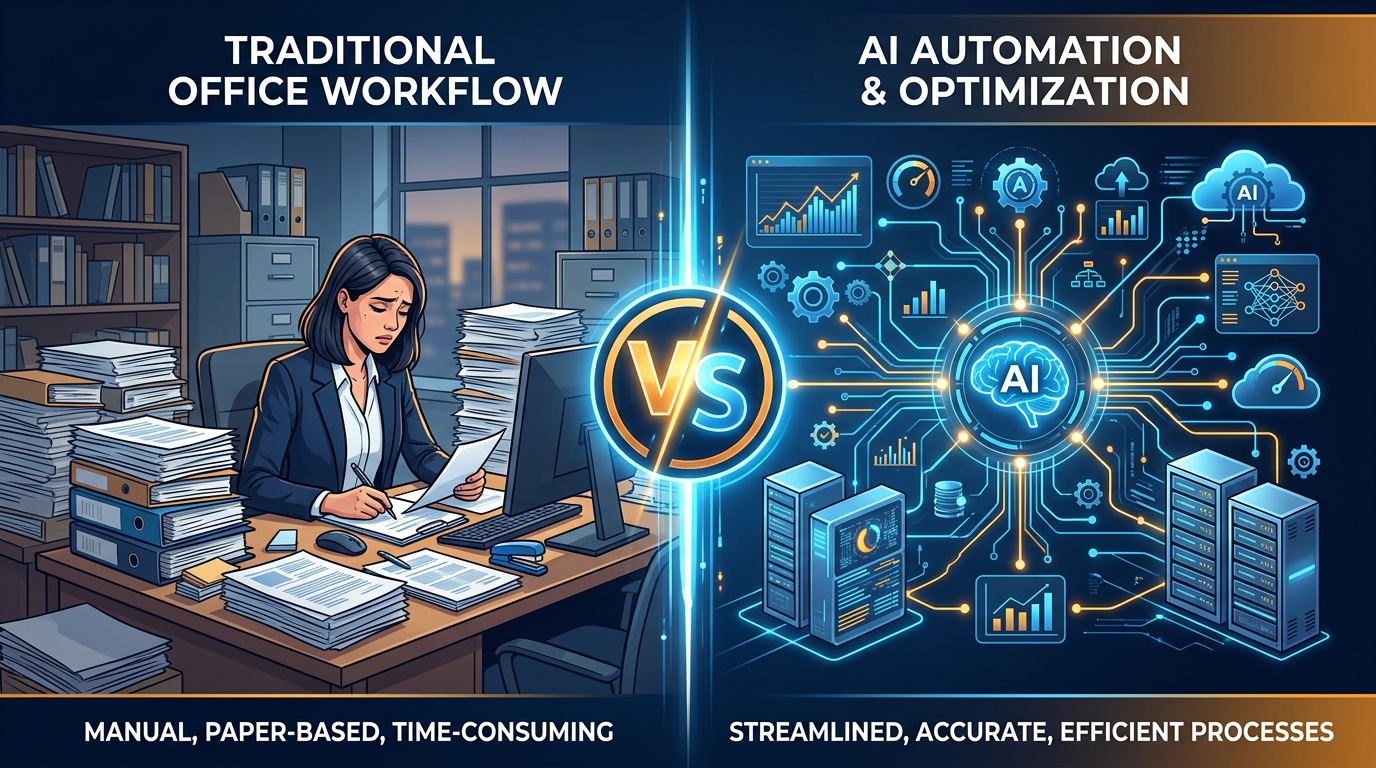
Then there is turnover. Bureau of Labor Statistics data shows the median tenure for wage and salary workers is roughly 2.3 years for employees under 35. That means many businesses are re-running the hiring playbook every two years—posting jobs, screening applicants, interviewing, onboarding—while the role sits empty for weeks.
AI automation does not call in sick, does not need health insurance, and does not quit after 18 months to take a competing offer. It is not a perfect replacement for every role, but for the tasks that eat up 20 to 30 hours a week of administrative grind, the math is hard to argue with.
When to Hire and When to Automate
Not everything should be automated, and not everything needs a human. The decision comes down to a simple framework: look at what the task actually requires.
If a task is repetitive, rule-based, and high-volume, it is a textbook candidate for automation. Think data entry, invoice processing, email sorting, appointment scheduling, and report generation. These tasks follow clear patterns, happen over and over, and do not require creative judgment.
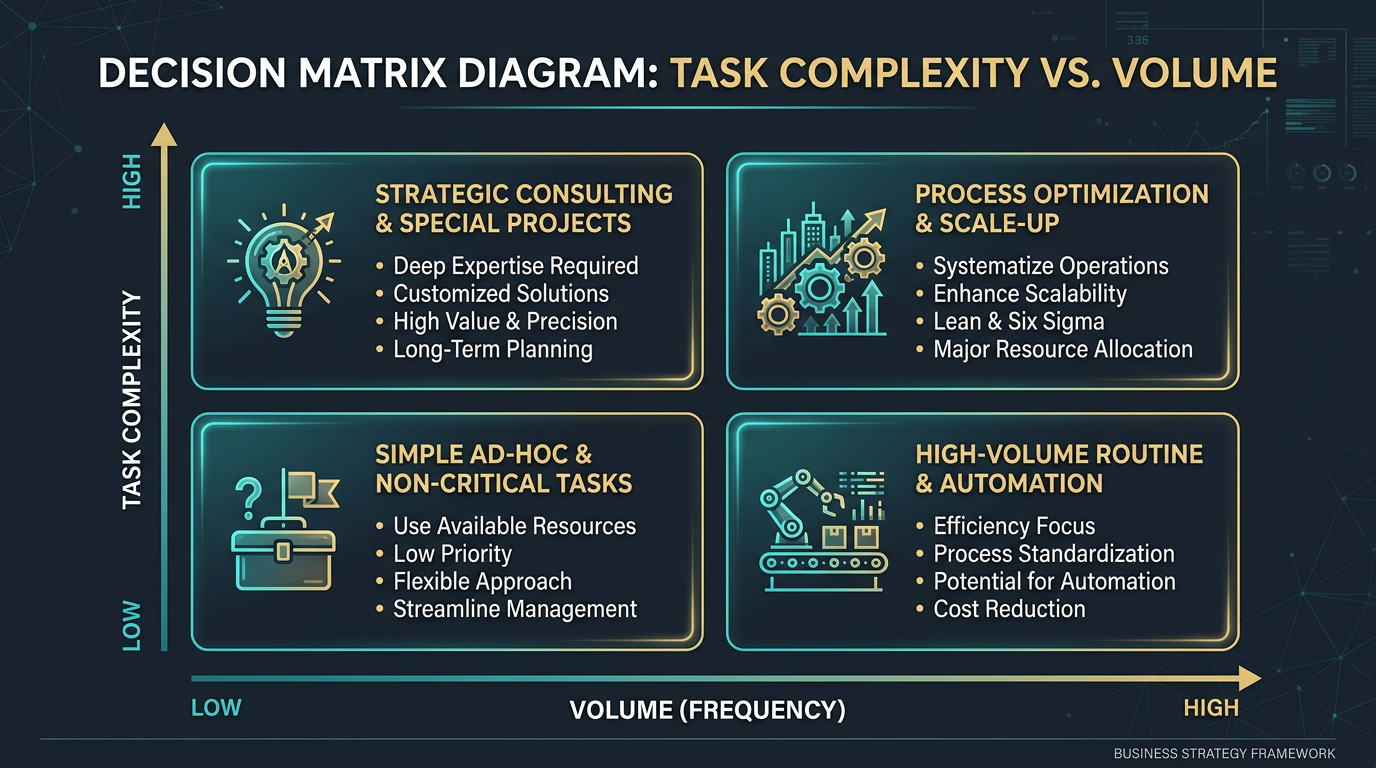
If a task requires creativity, relationship building, or nuanced judgment, hire a person. Closing a deal, managing a key client relationship, leading a team, or developing brand strategy—these are distinctly human strengths that AI cannot replicate.
The smartest approach is the hybrid model. Automate the boring, repetitive parts of a role so a human can focus on the high-value work. Here is what that looks like in practice:
Email triage, scheduling, data entry, and document prep are all high-feasibility automation targets. You might keep a part-time assistant for tasks that need a personal touch.
AI qualifies inbound leads, drafts follow-up emails, and keeps the CRM clean. The human handles actual conversations, objection handling, and relationship building.
Brand strategy, visual identity, and creative campaigns need human taste and judgment. AI can assist with research and first-draft copy, but the creative direction stays human.
What 1 in 4 Business Owners Learned the Hard Way About AI
According to recent survey data, roughly 25% of small business owners who tried AI tools reported limited or disappointing results. That is a real number, and it deserves an honest answer: why does AI work brilliantly for some businesses and fall flat for others?
The answer almost always comes down to the difference between a tool and a system.
ChatGPT is an engine. It is powerful, but an engine sitting on a garage floor does not take you anywhere. You still need someone to build the car—the intake process, the prompts, the data connections, the quality checks, and the workflow that ties it all together. Businesses that bought a subscription, asked a few questions, and expected magic were essentially buying an engine without a chassis.
The businesses that got real results did something different. They identified specific, measurable tasks (like “respond to the 40 support emails we get daily” or “generate weekly financial reports from QuickBooks data”). They built systems around those tasks with clear inputs, outputs, and error handling. And they measured the before-and-after.
That is the gap. It is not that AI does not work. It is that using a tool and building a system are two completely different things. The tool is the easy part. The system is where the value lives.
The Math: Why AI Pays for Itself in 90 Days
Let us walk through a real example. No hypotheticals, just math.
Say your business spends 20 hours a week on administrative work—email, scheduling, data entry, report generation, invoice processing. If you value that time at $75 per hour (whether it is your time or an employee’s loaded cost), that is $78,000 per year going toward tasks a machine can handle.
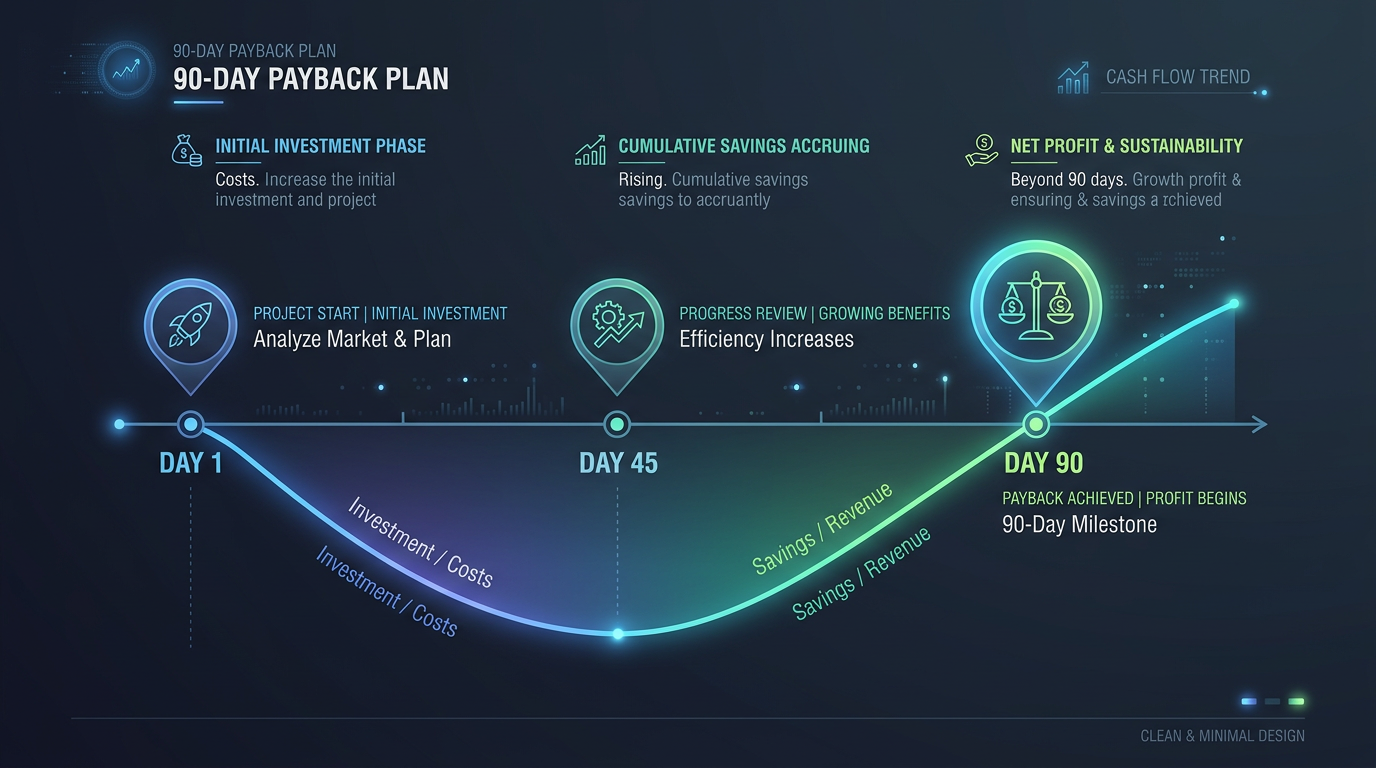
AI automation realistically handles 60% of that workload from day one. That is 12 hours a week freed up, or $46,800 in annual savings.
Even if implementation costs run $10,000 to $15,000 (on the high end for a comprehensive build), you break even in the first quarter. By month four, every dollar saved is pure margin. And unlike a hire, the cost does not increase year over year. There are no raises, no benefits inflation, no replacement costs.
Over three years, that same business saves roughly $120,000 or more compared to hiring for the same output. That is not a rounding error. That is an extra employee’s salary in profit.
The remaining 40%? That is where a part-time hire or a virtual assistant fills the gap—handling the nuanced, relationship-driven work that AI is not built for. You spend less on the hire because AI already took the grunt work off their plate.
Find Out What AI Can Do for Your Business
The calculator above gives you a quick snapshot. If you want the full picture, here are three ways to go deeper:
A 2-minute quiz that scores how prepared your business is for automation—and where to start.
Plug in your numbers and see the projected return on investment over 12 months.
See exactly how many hours per week AI can give back to you and your team.
Want to talk through it?
No pitch, no pressure. Just a straight conversation about whether AI makes sense for your business right now.
Email Us →