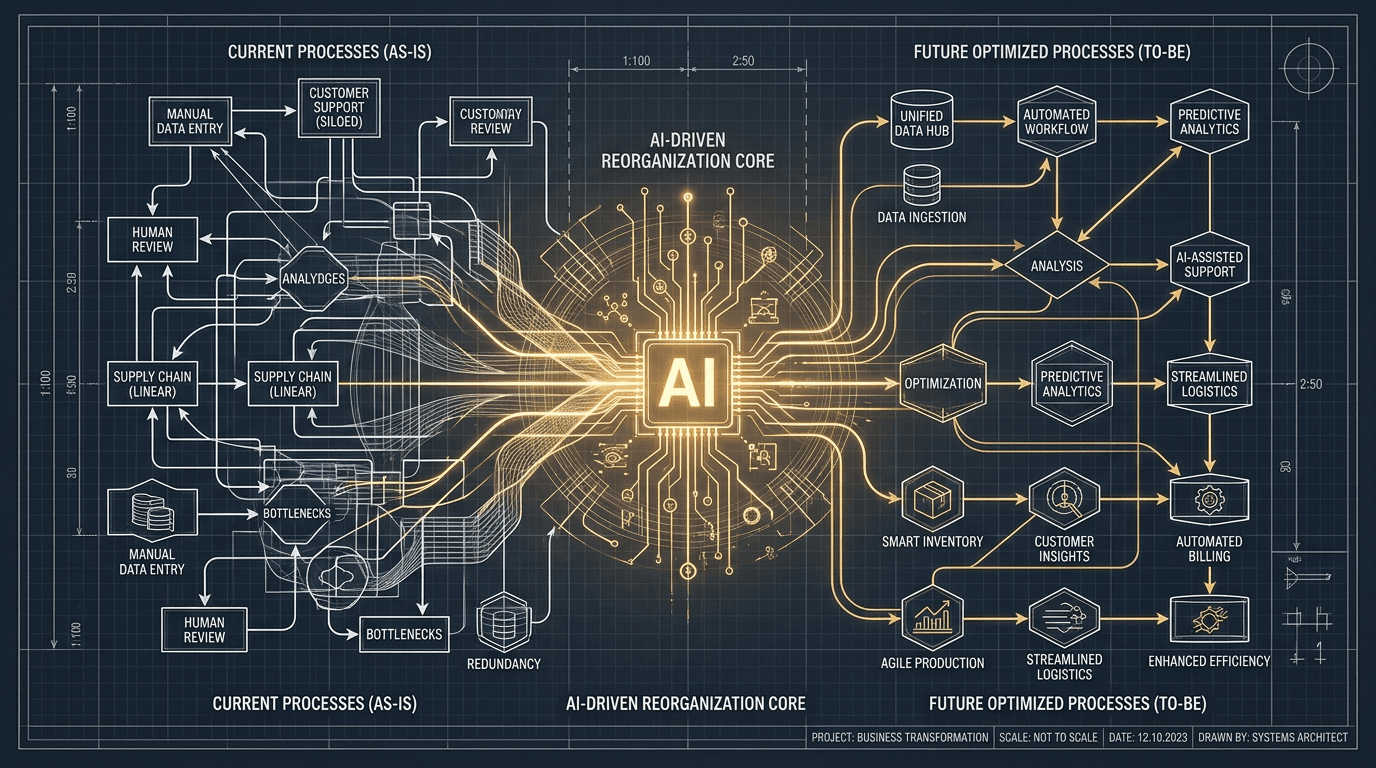
Not All Pain Points Are Equal
Every organization has process pain points. The challenge is distinguishing between irritants that feel bad but cost little and bottlenecks that quietly drain significant resources. Our analysis quantifies the actual cost of each pain point: hours lost, errors generated, revenue delayed, and customers frustrated. This converts subjective complaints into an objective priority list that guides where AI intervention will deliver the highest return. We measure before we prescribe.
Bottleneck Identification
We use queuing theory, throughput analysis, and work-in-progress measurement to identify genuine bottlenecks: the specific process steps that constrain overall system throughput regardless of how fast other steps operate.
Error Source Tracing
We trace errors back to their root cause through the process chain. A data quality issue in reporting may originate four steps earlier in a manual data entry process. Fixing the source eliminates errors throughout the downstream chain.
Cost-of-Delay Measurement
Every hour a process step takes beyond its optimal duration has a measurable cost: delayed revenue recognition, holding cost for inventory, SLA penalty risk, or opportunity cost of staff time. We quantify this in dollars per day.
Intervention Prioritization
Pain points are ranked by annual cost impact multiplied by feasibility of AI resolution. The highest-cost, most-automatable problems get addressed first. Lower-priority items are logged for future phases.
Analysis Approach
Collect
Gather pain point reports
Quantify
Measure cost and frequency
Trace
Find root causes
Prioritize
Rank by impact and feasibility
Recommend
Match solutions to pain points
Collect
Gather pain point reports
Quantify
Measure cost and frequency
Trace
Find root causes
Prioritize
Rank by impact and feasibility
Recommend
Match solutions to pain points
Pain Point Severity Map
Quantification Methods
Converting qualitative complaints into quantitative cost estimates requires rigorous methodology. We use multiple measurement approaches to triangulate the true cost of each pain point.
Time-motion analysis. We measure how long each process step takes, how much of that time is active work versus waiting, and how many times each step is repeated due to errors or rework. Staff cost per minute converts these measurements into dollar impact.
Error cost modeling. Every error has a cost cascade: the cost of detecting the error, the cost of diagnosing it, the cost of correcting it, and the cost of any downstream impact before correction. We model this cascade for each error type to produce true error cost figures.
Throughput impact analysis. Bottlenecks limit the entire system. We calculate how much additional throughput the overall process could handle if each bottleneck were relieved, then value that additional capacity based on revenue per unit or cost per transaction.
From Analysis to Action
The pain point analysis produces a prioritized list where each entry includes the annual cost of the problem, the recommended AI-based solution, the estimated implementation cost, and the projected payback period. This gives decision-makers everything they need to approve investment in targeted process improvements.
Contact us at ben@oakenai.tech to analyze your process pain points.